Michael Green

Journalist, producer and oral historian

  • Writing
  • Audio
  • Oral history
  • Projects
  • Book

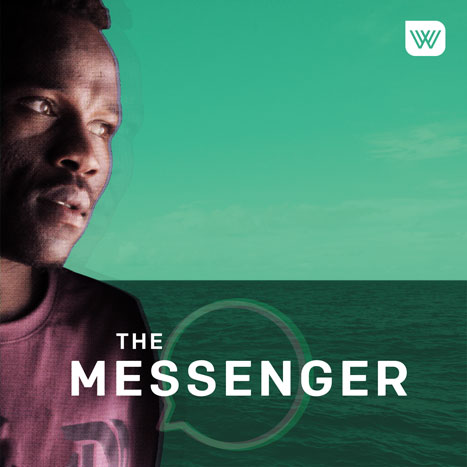
The Messenger podcast

In Audio on September 20, 2019

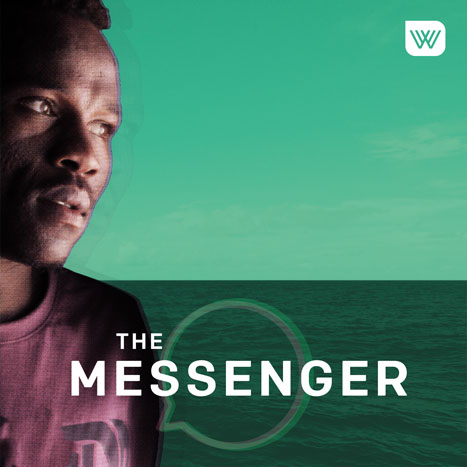
From Behind the Wire and the Wheeler Centre, The Messenger is a podcast about Abdul Aziz Muhamat and his life inside the Australian-run immigration detention centre on Manus Island.

Aziz and I have sent each other several thousand voice messages since early 2016. The Messenger reveals, in intimate detail, one man’s experience of what it’s really like to flee tragedy and seek asylum by boat.

The podcast won the Grand Award at the 2017 New York Festivals international radio awards, the 2017 UNAA Media Award for Best Radio Documentary, and the Australian Human Rights Commission Media Award. It won the 2017 Walkley Award for Radio/Audio Feature.

Subscribe to the feed now in iTunes or your favourite podcast app. Or listen via the links below…

 #1 Aziz, Not a Boat Number

In March 2016, Aziz and Michael first made contact. For more information, including a full transcript, extra links and credits, see The Messenger on the Wheeler Centre website.

#2 I Need to Format My Memory

Aziz begins to paint a picture for Michael of daily life in the detention centre. Where is it, and why is it there? More information about this episode.

#3 I Have Got Some People Waiting For Me

Aziz’s life has been a story of chance—and choice. He has been searching for a for a safe place for about eight years. What gives him the ability and the energy to speak out? More information about this episode

#4 Today I’m Really Smiling

A major ruling by the Papua New Guinea Supreme Court offers hope for Aziz – but, amidst the promise, the men receive devastating news from Nauru. Meanwhile, they’re encouraged to accept the option to resettle in PNG. So why doesn’t Aziz take it? More information about this episode

#5 A Safer Place

Stopping the boats. It’s one of the most fraught topics in Australian politics, and most of the time it comes out in two soundbites: saving lives at sea, and securing our borders. In this episode, Aziz tells Michael what it actually feels like to make that journey, and why he made the decision to get on a boat bound for Australia. What was going through his mind? Did he know what he was getting himself into before he stepped onboard? More information about this episode

#6 A New Plan

After months of interviews, Aziz finally sits facing an immigration officer and an interpreter, about to find out whether he’s been granted refugee status. But he’s too angry to talk about that. What he’d rather know is why he’s just spent weeks locked in a jail cell in Lorengau, before being abruptly released without charge. In this episode, Aziz tells Michael about the hunger strike that lead to his imprisonment, and why he continues to pursue big and small acts of resistance – despite the consequences. More information about this episode

#7 A Small Village

Even though Aziz is in detention, far away from both his home and from the country whose government is holding him, he’s on his phone all day. He’s hyperconnected. But his connection to the outside world is complicated and, despite their constant communication, Michael and Aziz never really get to have a regular, real-time conversation.

In this episode, Aziz observes his third Ramadan inside detention. And, along with many of the men on Manus, the Australian federal election campaign raises Aziz’s hopes. Meanwhile, Michael investigates the possibility of travelling to Manus Island. Could they really meet face to face? More information about this episode

#8 Kind Of A Dream

It’s July 2016. On the morning Michael flies to Manus Island, Aziz leaves the detention centre for the first time in nearly three years. In this episode, Aziz and Michael finally meet in person. Michael also meets some people from Manus Island, who explain how they feel about having the detention centre on their island.

Together with Behrouz Boochani, a Kurdish journalist and detainee, Aziz and Michael take a boat to a nearby island to swim, eat together, and escape the shadow of the detention centre. For Aziz, it’s an exhilarating time, full of new experiences and unexpected joys – but he knows it will soon come to an end. More information about this episode

#9 Freedom Is Not Free

Just before Christmas of 2016, Aziz is transferred to Port Moresby for knee surgery. With better phone reception, Michael and Aziz share a long phone call in which they reflect on the year that’s ending, the holiday season and the months since they met face to face on Manus Island.

The change in Aziz’s circumstances is only temporary, but it’s still a change – and the call feels like a rare break in the clouds. But just two days later – on Christmas Day – Michael hears news that Aziz’s friend and fellow Sudanese detainee, Faysal Ishak Ahmed, has died. More information about this episode

#10 It Runs In My Blood

After seven long months in Port Moresby recovering from knee surgery, Aziz finally returns to Manus Island. He’s overjoyed to be home in the detention centre – seeing his friends and sleeping in his old bed. But just as he returns, the Australian government begins shutting some of the centre’s compounds – trying to force refugees to go home, or accept resettlement in Papua New Guinea. Aziz and the other detainees refuse to leave.

This episode brought The Messenger into realtime. The closure of the Manus Island detention centre is expected to be complete by the end of October 2017. What will happen to the men who live there? More information about this episode

Hello Hello

With just ten days left before Australia closes the detention centre on Manus Island, Aziz leaves a few short voice messages, explaining how he is feeling.

Position is Clear

As the days count down to the end of October – when Australia has promised to close the detention centre on Manus Island – Aziz’s short voice messages outline the situation as he understands it, and how he intends to respond.

We Never Had Any Storm Like This

The security guards and other staff are leaving the detention centre. Aziz explains how the detainees are preparing for life without power.

We Are Just Ready

Mere hours from Australia’s deadline to close Manus Island’s immigration detention centre, tensions are running high amongst detainees. Why does Aziz seem calm?

We Wait for the Day to Make a Plan for Us

Three days after the official closure of the detention centre, several hundred detainees remain barricaded inside the gates without water, power or food supplied. Aziz describes the scene, and explains some of the ways the men are getting by.

We Are Hoping to Find a Way to Communicate

As the detainees’ isolation intensifies, Aziz tells Michael about the burden of his responsibilities – and his hope of some negotiation to end the stand-off Like many of the other men, Aziz has tried to shield his family from knowing about his predicament. But with reports about the centre emerging in international media, he is compelled to lie his brother, who’s recognised him in a photo.

There is a Reason

After Papua New Guinea’s Supreme Court rejects an appeal to restore power, water and food to the decommissioned detention centre, Aziz says the men never held much hope for a positive outcome in the first place. When Michael expresses concern about the ever-escalating situation, Aziz vents his mistrust of the courts and politicians, and defends the men’s decision to stay.

Everything That We Have Built

Hundreds of men remain in the decommissioned detention centre – refusing to be relocated to camps which many (including the UN’s refugee agency) have said are unfinished or unsafe. Papua New Guinean immigration officers have removed fences, shade and clotheslines from the camp. Rubbish bins storing rain and well water have been tipped out, and makeshift wells destroyed. In this update, comprised of Aziz’s weary and infrequent messages, he describes the increasingly strained situation.

We Are Just Living on a Daily Basis

Aziz reports that Papua New Guinean immigration officials have been entering the detention centre to destroy tanks and wells. Meanwhile, the men remaining in the camp have tried to avoid provocation and confrontation. Daily protests have moved to a cooler time of day to account for their lack of water and shade. Aziz says things are quiet in the camp, and spirits are generally positive. Michael arrives on Manus Island.

It’s Been 17 Days

Seventeen days into the stand-off with authorities, Aziz tells Michael about how men in the detention centre are dealing with the lack of water after tanks and wells were destroyed – as well as the men’s medical needs, many arising from the ad hoc water supply. And with New Zealand’s resettlement offer in the headlines, he reflects on why Australia has so far refused it.

We Are Looking After Each Other

Rain comes. In his voice messages, Aziz sounds unwell – but speaks at length about how, in spite of their living conditions, the men finally feel they have some control over their lives. He tells Michael about how they’re cooperating with each other, too – splitting duties like security and the daily cleaning of the compound.

‘We don’t always want to get the attention of the people about the hardship,’ he explains. ‘We are just paying the price for our freedom.’

I’m Not Really Settled Right Now

An eventful week has passed. After PNG immigration officials and police entered the decommissioned detention centre, destroying food, water and belongings, the 421 men remaining there are forced to relocate to the other facilities on Manus Island.

After a brief spell of homelessness, Aziz has found a bed in the East Lorengau transit centre. In a chance meeting with Michael, he explains how he’s adjusting to the new situation – and trying to regain his energy to continue working.

What I Can See Right Now

It’s raining on Michael’s last afternoon on Manus Island, and Aziz drops by to catch up. They discuss where things are at with Aziz and the other men, and what he expects will happen next. Then, it’s time to say farewell This episode will be the last of our short updates – but we’ll return soon with another full episode, unpacking what Michael found when he visited Manus Island.

#11 We lived as a nation

The detention centre on Manus Island might be closed, but Aziz – and the vast majority of the men who were held there – remain on the island, living in three different centres. By early 2019, Aziz is well into his sixth year, waiting. In that time, he’s felt free for only a few weeks – those few weeks when the immigration detention system disintegrated around him.

In this episode, The Messenger returns to late 2017, and the crucial period when Australia shut down the Manus Regional Processing Centre and the men refused to leave. We take you inside the centre as the standoff unfolds. There are no guards, no caseworkers, no immigration officials – and no food, water, medicine or electricity. Aziz and his friends are in charge. How did they survive? And why did they stay? More information about this episode.

#12 Flight from Manus

Aziz is shortlisted for a major international prize, the Martin Ennals Award for Human Rights Defenders. The ceremony is in Geneva, Switzerland. Improbably, the prize’s organisers secretly arrange permission for him to leave Manus Island to attend the event. 

In this episode, Aziz finally – temporarily – escapes Papua New Guinea, five and a half years after the Australian government took him there against his will. But he has no proper passport or visa, and no idea what to expect. After years of exile and captivity, how will it feel to visit Switzerland – one of the richest countries in the world? And can Aziz make any difference for those who remain stuck on Manus Island and Nauru? More information about this episode. 

#13 A Stranger in Geneva

Incredibly, Aziz is in Switzerland. And he’s just won a major international award for human rights defenders. He’s swamped with attention and adoration, briefings and business cards. But he is only allowed to be in Geneva for three short weeks. Then he has to return to Manus Island – back to the dangerous situation he’s being celebrated for campaigning against.

In this episode, we follow Aziz as he negotiates meetings with diplomats and speeches to the UN. He struggles with an unexpected, oppressive dilemma – should he board a plane back to his brothers on Manus, or seek yet another uncertain path to safety and freedom? More information about this episode.
She Called Me Red

In Social justice on September 3, 2018

“IF you have a grandmum, they will give you the worst nickname. Mine used to call me ‘Lalaya’. Lalaya means red. When I was very young—two or three—in the summertime, we don’t wear anything. Not even nappies, nothing. I was a little bit white, more than other family members, and when the sun hit me, I got red. Sunburnt. That was my nickname. My grandmum used to call out, she asked the other kids, ‘Where is Lalaya? Why isn’t he coming back?’ Like this. My aunties called me Lalaya too, or Lala. One of them still does. When I went to visit her in Bangladesh she cried a lot. She hugged me and cried.”

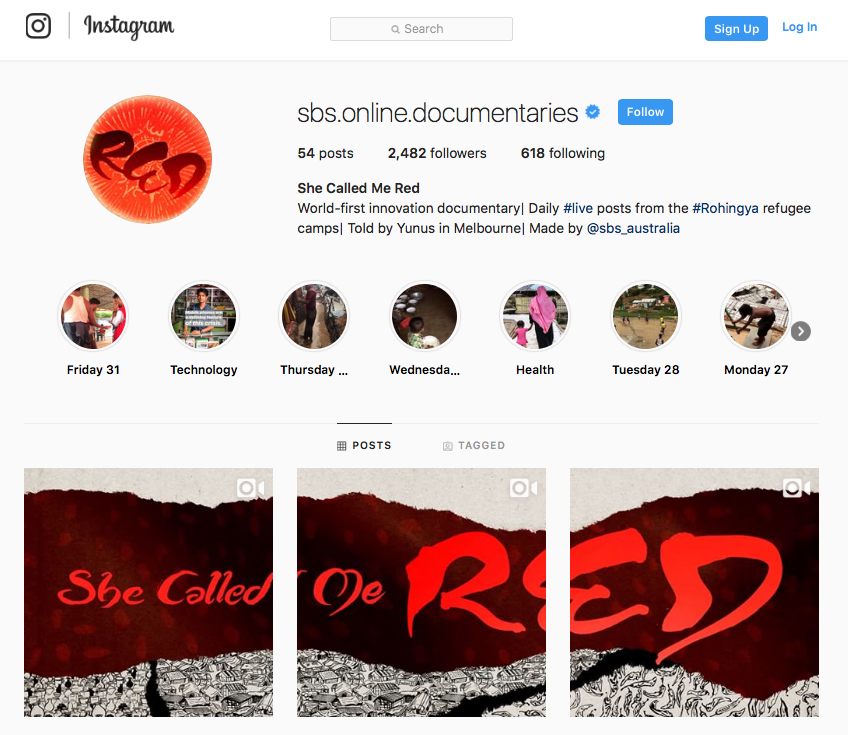
She Called Me Red, on Instagram @sbs.online.documentaries

That’s the first post in the SBS online documentary, She Called Me Red, about Yunus in Melbourne and his family in the refugee mega-camp near the border of Bangladesh and Myanmar. I’ve spent a lot of time with Yunus in the last few months. The documentary is out now, delivered via a series of posts—photos, artwork, text and videos—on Instagram.

The UN describes the violence against the Rohingya beginning in late August 2017 as genocide. This documentary reveals a small part of how it affected one family. You can view ‘She Called Me Red’ retrospectively in grid-view, starting from the bottom right corner of the account, and through the daily Instagram stories pinned at the top of the project.

Keeping it real

In Social justice on August 9, 2018

Who owns a story? Is it something a journalist takes from an interviewee or is it a collaboration?

IF you’ve read one quote about the ethics of journalism, it’s this, from Janet Malcolm: “Every journalist who is not too stupid or too full of himself to notice what is going on knows that what he does is morally indefensible.”

It’s the first line of her book, The Journalist and the Murderer, published in 1990. She goes on: “He is a kind of confidence man, preying on people’s vanity, ignorance or loneliness, gaining their trust and betraying them without remorse.”

Non-fiction writers are suckers for this quote. The afflicted and conflicted among us whisper it like confession; may it absolve our anguish. But the ruthless and thoughtless surely cherish it more, because it offers a tacit blessing: if it’s the craft that’s flawed, what else to do?

“I’m always a bit suss that people have only read the first page,” says Sharon Davis, a Walkley Award-winning journalist and academic. In lieu of a plot summary, this is Davis’s overview: “The journalist lied to the person he was interviewing. He lied over and over again. He made promises that he was never going to keep.”

The Messenger podcast

In recent years, I’ve been writing about Australia’s offshore immigration detention system. I spent countless hours exchanging voice messages with Abdul Aziz Muhamat, a Sudanese refugee on Manus Island, for The Messenger podcast, and I covered the closure of the detention centre for Harper’s Magazine. The men I’ve reported on remain there. I know I asked a lot of Aziz, and many others, in the course of my work.

So where does my journalism sit in Malcolm’s summation? If I don’t accept it’s immoral, am I thick? Or just not ruthless enough? After all, the practice of journalism is book-ended by two distinct approaches: at one end, I, the journalist own the story; at the other, the subject owns the story — it’s a collaborative effort.

Usually, but not always, investigative journalism takes the former approach.

Davis, for instance, has a particular interest in the criminal justice system, and that means reporting on vulnerable people. “The stories are really important to me — there are too many people in jail, too many people with addictions that aren’t being dealt with properly, too many women in abusive relationships. The challenge is finding a way to tell those stories and still sleep at night,” she says.

“I would never promise someone it’s going to be good for them, because I don’t think it is. There are a number of safeguards I try to put in place, but I never underestimate the pain people go through when they tell their stories.”

In 2012, she contacted the NSW Drug Court about documenting the way it works. Through the court, long-term addicts are released from jail so long as they join a strict rehabilitation program designed to end their addiction. It took 12 months to convince the court to give her access. Then, for two years, she followed the progress of seven people through the program. “It was a mammoth undertaking — a labour of love,” Davis says. She produced a three-part series for ABC Radio National, which first aired in 2015.

It was a risky proposition for everyone, including Davis. She was working with very vulnerable people who had long histories of drug addiction, sexual abuse — especially the women — and serious physical and mental health problems. They could be sent back to prison at any time. When she began, Davis told the participants very clearly what she wanted to do, and didn’t tape the first two interviews. She advised them to seek independent legal advice, and developed a consent form that acknowledged they’d done so. Their real names wouldn’t be used and they could stop at any time.

One quandary was whether, or how, she would intervene if she found out a participant was in danger. “Sometimes they would tell me things that made me very scared for them, particularly the women, about their housing or their domestic situation,” she says. She resolved to tell the court welfare officers to speak to the person — without spilling the details herself — and also told the person directly what she was doing. It was a hard line to walk.

I became very attached to a number of those people. My god, I wanted them to succeed. They would tell me stuff and I wouldn’t say anything at the time, and then I would come home and cry.”

The participants’ rapport with Davis was evident — the women called her “Shaz”. All were startlingly frank about their struggles and failings. Throughout the two years, as Davis conducted interviews once a week, she would often have to remind them that she was a journalist, that she was recording, and what they said could be used in the documentary.

Davis does not consider the work collaborative. She didn’t show or play the material to her interviewees before it was broadcast, but she sought to represent them fairly and with complexity. One of the men was occasionally verbally aggressive with her, but she chose not to use that tape, because that side of his character was evident in the way he spoke about the judge. She also left out some compelling information about one of the women, for fear it could put her at risk of violence. She called the woman to ask whether to include it.

“I could have made a very dramatic show from the drug court but I chose not to,” Davis explains. “I really wanted to focus on whether the court’s program works — the material had to be about what was happening in these people’s lives and how that impacted whether they would succeed.”

The Media Entertainment and Arts Alliance’s code of ethics comprises only 500 words, and it doesn’t — can’t, really — provide guidance on managing deep personal relationships. Most relevantly, clause eight states: “Use fair, responsible and honest means to obtain material… Never exploit a person’s vulnerability or ignorance of media practice.”

“The code is a very useful starting point, but the whole question of consent isn’t even mentioned,” says Denis Muller, who teaches media ethics at the University of Melbourne. A major review published in 1997 proposed an expanded version, including the direction that journalists should “interview only with informed consent”, as well as a guidance clause noting that values conflict and that “ethics requires conscientious decision-making in context”. But it wasn’t adopted.

Muller stresses the importance of journalists being transparent about the purpose of the story, and giving people an opportunity to respond to criticism. “If you do those two things, I don’t see how betrayal or deception come into it,” he says. “Janet Malcolm extrapolated from one unusual example and I think that has discouraged a lot of journalists unnecessarily.”

But in stories where you develop a relationship with someone over time, Muller warns of another ethical concern — the risk of capture.

You begin to like the person and empathise with their position, and that can colour the way you report it.”

His approach is that the journalist must take responsibility for the story. To avoid bias, you have to question yourself, reassess the facts, strive for impartiality or transparency. Likewise, on questions of representation, Muller contends that a journalist ordinarily shouldn’t show an interviewee the work. If you’re unsure whether something is correct, or fair, or intrusive, or may put someone at risk, seek clarification from them on that point, rather than approval for the whole piece. “Otherwise I think you’re passing too much responsibility for the story onto the subject and not shouldering it yourself.”

At the other end of the spectrum is Danny Teece-Johnson, a journalist with NITV in Sydney. He’s a Gomoroi man from Moree in northern New South Wales, but began his career in the Northern Territory. He approaches his work expressly as a collaboration. “The NT mob are very different in their tradition and connection to country, so I always took the position that they’re the experts,” he says. “The communities hold the answers. They know the problems, they know how to fix them.”

Teece-Johnson aims to make the community feel like they’re controlling the story and asks interviewees to drive the narrative. “Generally, for Aboriginal people, the mainstream media has been pretty negative,” he says. “So I decided I’d do the opposite of what they do. My notion is that everything is off the record until someone tells me to put it on record. I think it’s absolutely ethical to show people the stories before they go to air, because it’s their knowledge you’re taking and putting out there.”

It’s his practice to speak openly with people about the content of his stories, show them the material, and seek clarification. Teece-Johnson believes it’s possible to use this collaborative approach even when a story is unflattering, or involves conflict, or when someone isn’t being honest.

For me, it’s about not hiding behind your keyboard, but going to see that person and talking about it. I think that alleviates a lot of the stress.”

Although he’s conscious of the power dynamics dissected by Janet Malcolm, Teece-Johnson says he’s guided by a belief that journalism should empower people and communities to make change. He counters with a different quote, from Ethel L Payne, an African-American journalist celebrated for her coverage of the civil rights movement: “the black press is an advocacy press”.

Although his approach is shaped by his conception of Aboriginal journalism, he argues all journalists can work collaboratively with their interviewees, where the stories permit. It’s a way to avoid the long history of appropriation and misappropriation, especially when journalists are outsiders to the communities they’re writing about.

Collaboration does not necessarily mean the resulting stories are “softer”. Take Anjali Nayar, a Canadian journalist who has reported extensively from Kenya and elsewhere in Africa. For her, collaboration not only affects how people are represented, or even which side of the story is told, but whether an important story gets told at all. In the early scenes of her new documentary Silas, about illegal logging and corruption in Liberia, Silas Siakor is sitting in the back of a car that passes a truck hauling logs. There should be no forestry in that region, so he leans out the window to take a photo.

That was in 2011. The logging was happening in secrecy, so it was difficult to figure out how much of an issue it really was. In the years that followed, Nayar collaborated with Siakor to develop an app to collate evidence of an extraordinary land grab that saw nearly a quarter of Liberia handed to private logging companies in just two years. “The only real solution to [investigating the scale of the illegal logging] was to give people the ability to participate in that narrative,” Nayar says. “To use technology to help groups be part of the storytelling.”

The app, Timby, is a closed system, enabling people to upload, gather and share evidence such as geolocated photos, videos and notes with a group of trusted people over time. Nayar calls it community journalism, because it facilitates investigations of long-term issues (in contrast to citizen journalism, which operates for flash crises or incidents). In Silas, the evidence people collected using Timby changed the story. It went from the smaller issue she’d set out to cover, about logging companies and communities, to an exposé of corruption that implicated the country’s Nobel Prize-winning president, Ellen Johnson Sirleaf.

Nayar’s lesson was that collaboration teaches you the right story to tell. “We don’t know what we think we know,” she says. “If I walk into a Liberian community, I’m never going to get this story. I can’t be there and experience it in the way it happens on the ground.”

Back to The Journalist and the Murderer — if the first lines are too glib, let’s skip to the last page instead. In her final paragraph, Malcolm writes: “There is an infinite variety of ways in which journalists struggle with the moral impasse that is the subject of this book. The wisest know that the best they can do… is still not good enough.”

Like the other journalists I spoke to, I take this not to mean that betrayal is inevitable, or that collaboration implies compromise, but that chroniclers should sit uncomfortably at our keyboards, our power vexing us like a stiff neck. Malcolm’s ending seems like the right place for the discussion to begin.

This story was published in The Walkley Magazine, July 2018, and online at Medium with great illustrations by Tom Jellett.

No Exit

In Social justice on June 15, 2018

[Letter from Manus Island, Harper’s Magazine, July 2018]

The ongoing abuses of Australia’s refugee policy

LIGHTENING flashed behind the fiberglass banana boat, but ahead of us the night sky was clear and the water was calm. Ezatullah Kakar, a Pakistani refugee, and I were in the South Pacific Ocean, 2 degrees shy of the equator, just off the coast of Papua New Guinea’s Manus Island. As we cut smoothly through the flat sea, one of the men aboard passed the skipper a beer. The mood was tense and quiet, the three-man crew speaking only when necessary. Kakar didn’t share their apprehension. He took out his phone, ran one hand through his wavy hair, threw his arm around me, and snapped a moonlit selfie of the two of us. I must have looked nervous, because Kakar smiled encouragingly at me. “I believe if we are doing good things, no one will catch us,” he said.

Read this article in Harper’s Magazine, July 2018

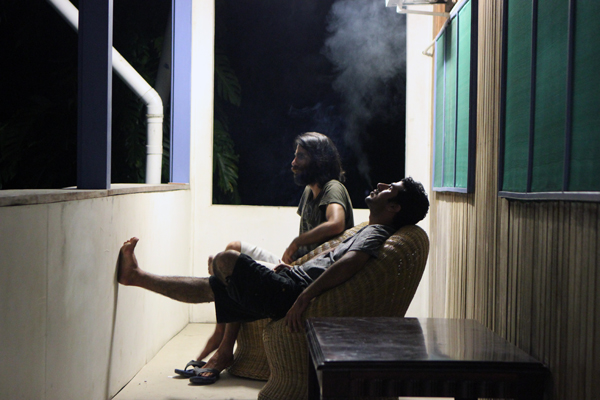
Benham Satah and Behrouz Boochani in Lorengau, November 2017. (Photo by Michael Green.)

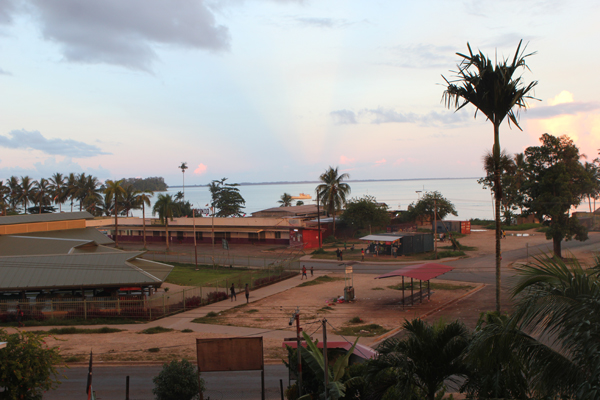
Lorengau town centre at dusk. (Photo by Michael Green.)

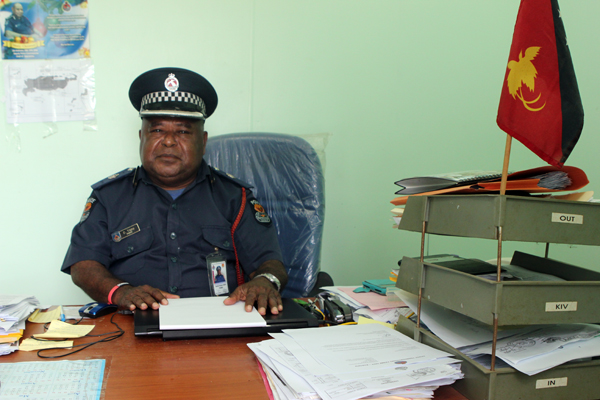
Provincial Police Commander David Yapu at his desk in Lorengau, Manus Island. (Photo by Michael Green.)

Faces of the Rohingya

In Community development, Social justice on May 31, 2018

Across the road from Springvale train station, about 20 kilometres southeast of Melbourne’s CBD, there is an unmarked café—the Rohingya Bazaar.

Along one wall, shelves are stacked with produce from Myanmar—biscuits, rice, noodles, spices and sauces. There are few customers but they stay a long time, sitting on the orange plastic chairs and talking at the long row of tables in the middle of the shop, or charging their phones at the tables by the other wall. People order coffee with condensed milk, or a plate of rice with curries from the bain-marie. Young men step outside for a cigarette and then return. One man has the remote control for the TV and chooses a string of Taylor Swift video clips from YouTube.

Shawfikul Islam comes in, wearing double denim and a backwards baseball cap. He arranged to meet here, but he’s late because he has been at the police station, helping interpret for two men who were in a dispute. The Rohingya are a Muslim ethnic group in Myanmar—although the country’s government refuses to use the word ‘Rohingya’, and considers them illegal immigrants from Bangladesh. Shawfikul explains that there are 500 Rohingya in Melbourne—mostly living in Springvale—and about 3000 in Australia. Mainly, they are young men like him. “For Rohingya boys growing up, the dream is to escape,” he explains. “We’re the most unwanted community in the world.”

Shawfikul begins to introduce people in the community, starting with Kabir, the owner of the café.

Read more, and see Tia Kass’s illustrations, at SBS online

This is an illustrated feature for SBS, with short profiles of eight people from the Rohingya community in Melbourne. 

  • « Previous Page
  • 1
  • 2
  • 3
  • 4
  • 5
  • …
  • 81
  • Next Page »

© Copyright 2017 Michael Green · All Rights Reserved