Michael Green

Journalist, producer and oral historian

  • Writing
  • Audio
  • Oral history
  • Projects
  • Book

Fear & Wonder

In Audio on May 26, 2023

Published by The Conversation, Fear & Wonder is a documentary podcast that takes you inside the UN’s era-defining climate report, via the hearts and minds of the scientists from all around the world who wrote it.

I made this show because I happened to visit my friend and co-host Dr Joëlle Gergis – a climate scientist – the day after my in-laws’ house burned down in Australia’s terrifying Black Summer bushfires. She was in the thick of her work on the IPCC’s latest monumental report. I realised that I had no idea how we know what we know about climate change. And I wanted to find out.

In this seven-part series, I speak to scientists from 14 different countries about their science, how they do what they do, and what it feels like to carry that knowledge. We trace the work behind these extraordinary reports as the years pass and climate disasters befall almost everyone involved.

Subscribe here

On the chain

In Social justice on July 1, 2021

For The Monthly, André Dao, Sherry Huang and I wrote about the Chinese workers at the centre of a dispute at the Midfield abattoir in Warrnambool. It begins like this:

In May 2016, Jack Zhao posted to a private Facebook page to advertise for meatworkers at Midfield Meat International, an abattoir in Warrnambool on Victoria’s southwest coast. “Today,” he wrote in Mandarin, “is an important day. I am happy to announce that we are about to expand our business. Ten years ago, the first group of Chinese 457 visa holders arrived at Midfield and boosted our revenue up to ten times! We became one of the top 50 private corporations in the country. Today, another 50 Chinese 457 visa holders arrived at Midfield.”

Though Jack Zhao wrote of “we” and “our”, he was not actually employed by Midfield. Instead, he was a labour hire contractor, tasked with recruiting workers from China, Hong Kong and Taiwan for Australian abattoirs. But without any Mandarin-speaking supervisors, the company effectively relied on Zhao and other labour hirers to manage its foreign workforce. Zhao’s Facebook post outlined what the latest round of recruits could expect: “Good 457 workers will get your PR status, you will have five things in your hand: wife, kids, house, money, car! As long as you are a hard worker, here is your great opportunity.”

Naturally, such an opportunity doesn’t come cheap. Some of these new migrant-worker recruits had paid a Chinese broker up to $70,000 to have a shot at “PR”, shorthand for a visa with permanent residency: the 186 visa allows the holder to live in Australia indefinitely, with work and study rights, access to Medicare, the ability to sponsor relatives, and a pathway to Australian citizenship. This, then, was the bargain: find the money or borrow it against your future wages and work for a single abattoir for at least three years on a temporary 457 visa, with limited rights, and, in return, you would get the promise of a ticket to the lucky country.

Facilitating these opportunities is a big business. Zhao’s boss was Zu Neng “Scott” Shi, the director of a network of dozens of labour hire companies providing foreign workers to at least 42 abattoirs around Australia. Between 2008 and 2017 his syndicate generated $349 million in revenue from meatworker recruitment. There was also money to be made exporting the meat. Shi appeared on the Chinese government–owned China Central Television as the “beef boss”, touting his access to high-quality Australian meat for import. The business is opaque: in 2018, the Australian Tax Office accused Shi and his companies of phoenixing – the practice of liquidating a company once it gets into trouble, only to incorporate it again under a new name – and of owing $163 million in unpaid taxes. An industry insider explains the trade like this: “It’s all to do with blood, muscle and bone. It just happens that some is alive and some is dead.”

Read more at The Monthly.

Cath and Jack and the firestorm in Dale Place

In Audio on March 4, 2021

L to R: Dougie, Jack and Cath

For ABC Radio National’s documentary show Earshot, I produced a 35-minute story about one couple’s terrifying experience of bushfire. It’s a thriller, and a love story, and you can listen here, or via Earshot on your favourite podcast app.

When the Black Summer firestorm hits her street , Cath runs for her life—leaving her partner Jack, who’s hellbent on staying to defend their home. They lose each other. Later, among the shock and the chaos, it hits her: Oh my god, where is Jack? What’s happened to him?

As the catastrophe unfolds, Cath Bowdler, Jack Egan, and Channel Ten news journalist Daniel Sutton describe what happens to them on New Years Eve 2019, on the South Coast of NSW.

Listen: Cath and Jack and the firestorm in Dale Place

Producer: Michael Green

Composer and sound engineer: Matthew Crawford

Supervising producer: Claudia Taranto

The Wait podcast

In Audio on November 3, 2020

Mozhgan Moarefizadeh is stuck in Jakarta, living without rights—but with a yappy dog named Bella. With journalist Nicole Curby, she brings you into the lives of refugees like her, who are trapped on Australia’s new borderline, in Indonesia.

The Wait is a five-part narrative podcast, two years in the making. Published by The Guardian and supported by the Walkley Foundation, The Wait is a compelling and innovative combination of in-depth interviews, field reporting, audio diaries and conversations. I’m co-writer and supervising producer for the show.

Check out the website for photos and more information. Subscribe now, on iTunes, Spotify or wherever you get your podcasts. Or just listen below…

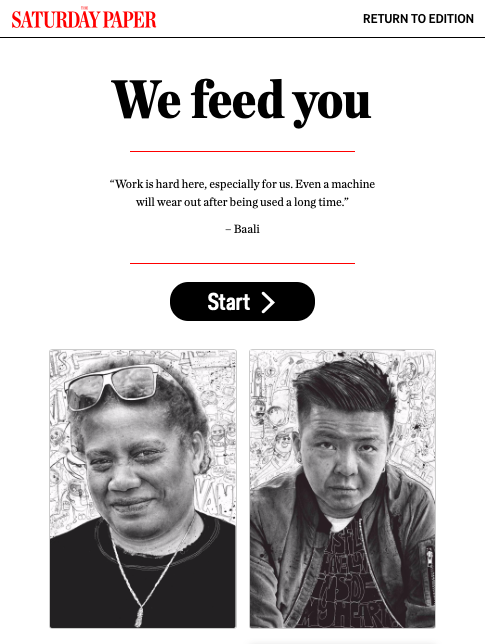
We feed you

In Social justice on May 20, 2020

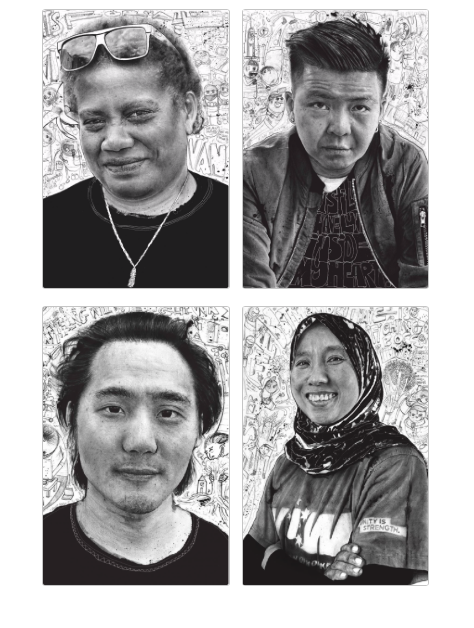
For The Saturday Paper and the Walkley Foundation, André Dao and I met four people living in Australia, working along the food chain.  This multimedia story was illustrated by Tia Kass. It won the Melbourne Press Club’s 2020 Quill Award for reporting on multicultural affairs.

Senator WALSH: Can the minister explain why… temporary migrant workers who can’t go home… have been excluded from the JobKeeper program?

Senator CASH: I thank the senator for her question… In relation to the senator’s question: because the government had to draw a line somewhere. 

– Senate Hansard, April 8, 2020

Over the last two decades, low paying work has increasingly been done by workers with no right to stay in Australia. It is especially the case in the food system. Temporary migrant workers plant, pick, pack, slaughter, slice, cook and deliver food for everyone else. 

Twin senate inquiries, into temporary migration and underpayment, are due to report at the end of the year. They have received more than 170 submissions so far, but few contain testimony from migrant workers. 

In this story, you can read about Jennifer Banga, Tiff Tan, Baali and Putri Nazeri—and listen to their voices and watch their videos.

Illustrations by Tia Kass

  • 1
  • 2
  • 3
  • …
  • 81
  • Next Page »

© Copyright 2017 Michael Green · All Rights Reserved